
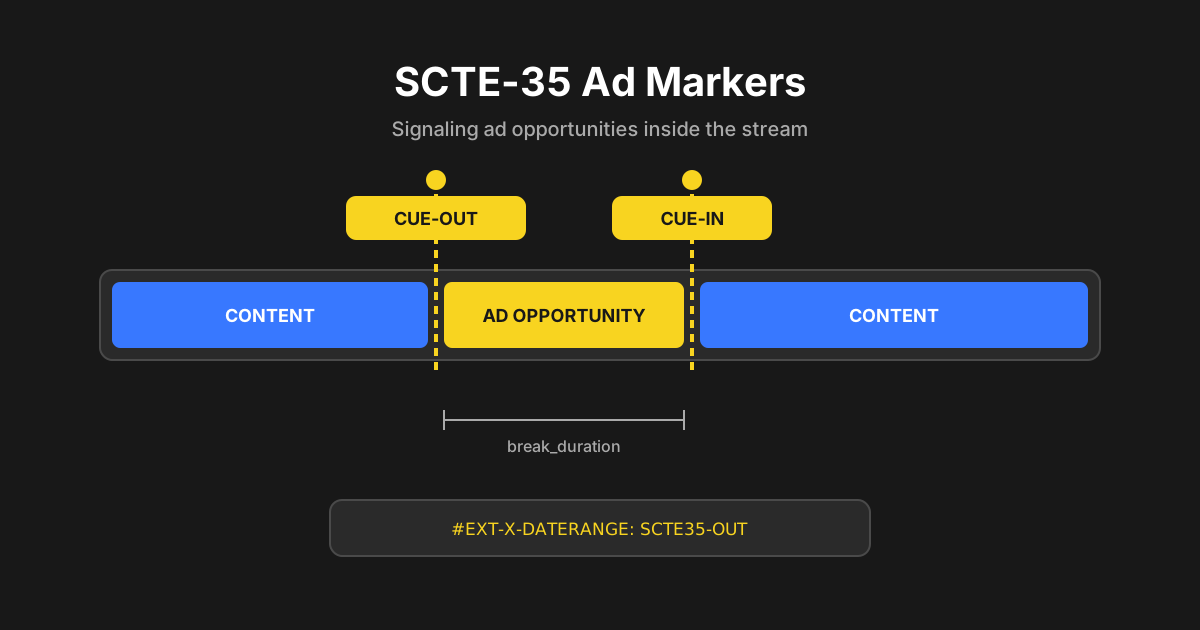
If you work anywhere near streaming advertising, you have heard the term SCTE-35. It appears in every ad insertion architecture diagram, every MediaTailor configuration guide, and every conversation about dynamic ad insertion. Yet for something so central to how CTV advertising actually works, clear and practical explanations are surprisingly hard to find. This guide covers what SCTE-35 markers are, how they travel through a streaming workflow, and how modern platforms are using them to unlock far more than traditional ad breaks.
SCTE-35 in Plain Language
SCTE-35 is a standard published by the Society of Cable Telecommunications Engineers that defines how to signal events inside a video stream. In practice, it is the industry's common language for saying "something important happens at this exact moment in the content" — most commonly, "an ad opportunity starts here and ends there."
The standard was born in the cable television world, where local operators needed a reliable way to splice regional commercials into national feeds. As television moved to IP delivery, SCTE-35 moved with it. Today the same markers that once triggered cable splicers now drive server-side and server-guided ad insertion across HLS and MPEG-DASH streams on every major CTV platform.
The Anatomy of a Marker
An SCTE-35 message is a compact binary structure carried alongside the video. The most important message types are the splice insert and the time signal. A splice insert is the classic instruction: it says an ad break begins at a given presentation time and typically includes the planned duration. A time signal is more flexible — it points to a segmentation descriptor that can describe program boundaries, chapter starts, blackout windows, or provider ad opportunities with much richer metadata.
In transport streams, these messages ride in their own packet stream multiplexed with audio and video. In HTTP streaming, they are translated into manifest decorations: EXT-X-DATERANGE or EXT-X-CUE-OUT tags in HLS playlists, and Event or EventStream elements in DASH manifests. The marker itself is small, but its placement precision is everything — a marker that drifts even a second from the intended frame produces visibly broken ad transitions.
A marker that drifts even a second from the intended frame produces visibly broken ad transitions. Precision is not a nice-to-have in SCTE-35 workflows; it is the entire point.
How Markers Flow Through a Streaming Workflow
A typical journey looks like this. First, the marker is created — either upstream by a broadcast automation system, or at the encoder or packager for streaming-native content. Live sports productions often fire markers manually or semi-automatically from the control room as play stops and starts. Next, the encoder and packager must condition the stream around the marker: segment boundaries are aligned to the splice point so that a downstream system can switch content cleanly, and the marker is passed through into the manifest rather than dropped.
Finally, an ad insertion system acts on the marker. With server-side ad insertion, a service such as AWS Elemental MediaTailor reads the cue, calls an ad decision server, and stitches the returned creative into the stream. With server-guided approaches, the marker is surfaced to the client application, which renders the ad experience itself while the server coordinates the decisioning. Either way, the SCTE-35 marker is the trigger that sets the whole chain in motion.
Where SCTE-35 Workflows Go Wrong
Most real-world SCTE-35 problems fall into a few recognizable categories. Markers get dropped when a transcoder or packager in the chain is not configured to pass them through. Timing drifts when pre-roll values are miscalculated or when segment boundaries are not conditioned to the splice point, producing ads that start mid-scene. Duration mismatches occur when the break runs shorter or longer than the marker declared, leaving dead air or clipping content. And in multi-vendor chains, subtle differences in how each system interprets segmentation descriptors can silently change the meaning of a cue.
The practical advice is simple to state and hard to do: validate markers at every hop. Inspect the manifest that your ad insertion system actually receives, not just what the encoder claims it sent, and test with the real player and device matrix your audience uses.
Beyond the Ad Break: Markers as In-Content Opportunities
Here is where SCTE-35 gets genuinely exciting. The standard signals moments, and nothing says those moments must be full-screen interruptions. A time signal can just as easily mark a stoppage in play, the start of end credits, a scene transition, or a replay segment. Forward-looking platforms treat these markers as triggers for in-content ad formats: an L-band that frames the content during a break in play, a double-box that shares the screen during a replay, a squeeze-back over end credits, or a shoppable overlay tied to a specific scene.
This is precisely how ITG's signaling system works. It consumes SCTE-35 cues — alongside other event sources — and uses them to trigger non-intrusive ad units on the client via lightweight SDKs, coordinated with server-side workflows such as AWS Elemental MediaTailor. The same marker that once meant "cut to commercial" now means "open a monetization opportunity without leaving the content." The results speak for themselves: in-content formats delivered this way achieve 3.8x higher attention rates and 47% higher engagement compared to traditional linear ad breaks.
SCTE-35 and SGAI: A Natural Pairing
Server-Guided Ad Insertion (SGAI) leans on SCTE-35 more heavily than any approach before it. Because SGAI splits responsibilities — the server decides, the client renders — both sides need a shared, frame-accurate understanding of when opportunities occur. SCTE-35 markers, surfaced through HLS interstitials or DASH events, provide exactly that shared timeline. If you are evaluating SGAI for your platform, auditing the quality and coverage of your SCTE-35 signaling is the single best first step.
Getting Started: A Practical Checklist
Confirm your encoder and packager pass SCTE-35 through end to end, and verify the markers appear in the manifests your players actually fetch. Align segment boundaries to splice points. Standardize on the segmentation descriptor types your workflow will honor, and document them for every vendor in the chain. Then start small: pick one marker type — a break in play, or end credits — and attach a single in-content format to it before scaling out.
Turn Your Markers Into Revenue
Most streaming platforms already have SCTE-35 markers flowing through their pipelines — and most are using them only for conventional ad breaks. ITG's signaling system, SDKs, and ad server turn those same markers into non-intrusive, in-content ad opportunities across Roku, Fire TV, Apple TV, Samsung, LG, mobile, and web. Contact us to see what your existing signaling can unlock.