
Every piece of video content contains moments that viewers half-watch: the end credits, the recap of last week's episode, the slow pan back to the studio after a highlight. Traditional advertising ignores these moments entirely, waiting instead for a full commercial break. The squeeze-back — one of broadcast television's most proven formats — monetizes them without cutting away from the content at all. And thanks to modern CTV technology, it is no longer limited to national broadcast control rooms.
What Exactly Is a Squeeze-Back?
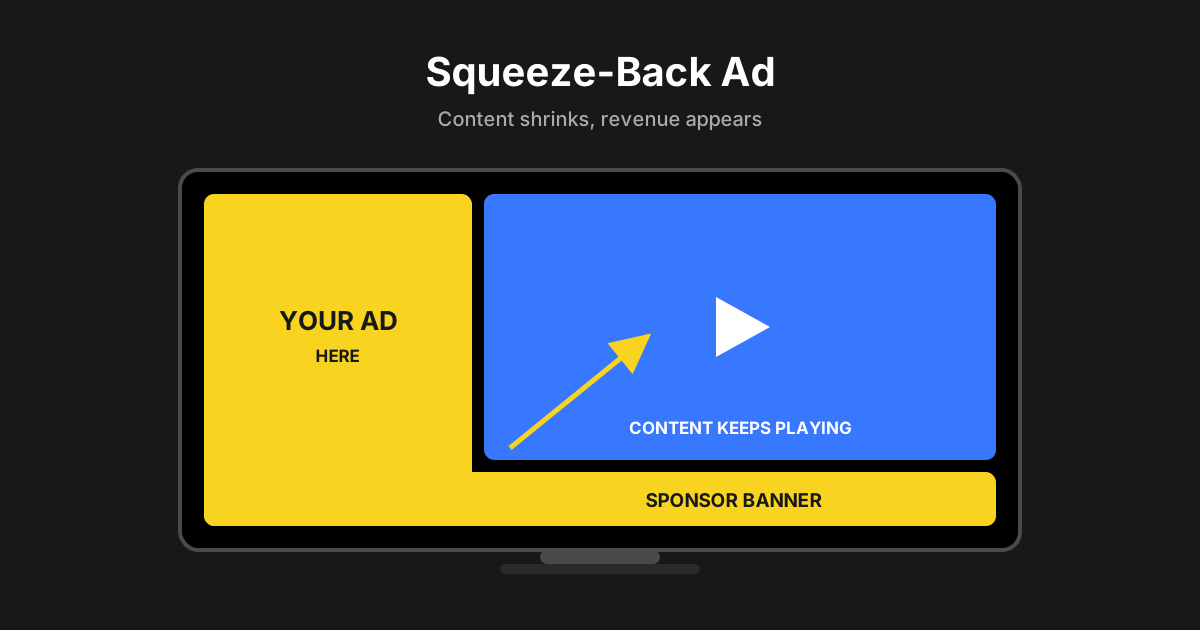
A squeeze-back (sometimes called a squeeze-frame or squeeze-and-tease) is an ad format in which the video content dynamically scales down — shrinking into a corner or a reduced window — while the revealed screen space displays an advertisement. The content never stops playing and its audio typically continues, so the viewer stays connected to what they were watching while the brand message occupies the newly available real estate.
If you have ever watched end credits shrink to half the screen while a network promoted its next show, you have seen a squeeze-back. Broadcasters have used the technique for decades precisely because it retains viewers through moments when they would otherwise change the channel. What is new is the ability to trigger, target, and sell these placements programmatically on streaming platforms.
Where Squeeze-Backs Shine
The format is at its best in content moments that carry the story forward but do not demand full-screen attention. End credits are the canonical example: the content is technically still playing, viewer attention is available, and a squeeze-back monetizes the moment without triggering the "skip credits" reflex. Sports broadcasts offer even more opportunities — replays, stoppages, timeouts, and the walk back to the huddle are all natural squeeze-back windows where the game remains visible while a sponsor takes the stage.
Scene transitions and recap segments in episodic content work similarly. The unifying principle: the viewer keeps watching, the platform keeps monetizing, and neither interrupts the other.
The unifying principle of the squeeze-back: the viewer keeps watching, the platform keeps monetizing, and neither interrupts the other.
Squeeze-Back vs. Other In-Content Formats
The squeeze-back belongs to a family of in-content ad units that includes L-band ads, double-box (split screen) ads, overlays, and pause ads. The distinction is in how the screen is shared. An L-band frames the content along two edges without resizing the moment's composition; a double-box gives content and ad roughly equal panels; an overlay floats above the content. The squeeze-back is the most dramatic of the family — it actively resizes the content window with an animated transition, which makes it exceptionally attention-grabbing while still preserving content continuity.
That animation is also why squeeze-backs command premium pricing. The motion of the content shrinking naturally draws the eye toward the revealed ad space, delivering the attention of a full-screen ad with the viewer goodwill of a non-intrusive one. In-content formats of this kind achieve 3.8x higher attention rates and 39% higher brand recall compared to traditional linear breaks.
How Squeeze-Backs Work Technically on CTV
Delivering a squeeze-back on streaming requires three coordinated pieces. First, a trigger: an SCTE-35 marker or an equivalent event identifies the moment — credits starting, play stopping, a transition beginning. Second, a decision: an ad server selects the creative for that viewer, applying the same targeting and programmatic demand used for any other impression, with standard VAST compatibility. Third, rendering: a client-side SDK animates the content scale-down and composites the ad into the revealed space, frame-accurately and without re-encoding the stream.
This is the architecture ITG has built end to end. Our signaling system consumes the triggers, our ad server and ITG Demand handle decisioning and programmatic monetization, and our SDKs render the squeeze-back natively on Roku, Fire TV, Apple TV, Samsung, LG, Hisense, mobile, and web. The approach integrates with AWS Elemental MediaTailor, combining server-side workflows with client-side rendering so the format works consistently across live sports and VOD alike.
Selling the Squeeze-Back: Direct and Programmatic
Historically, squeeze-backs were sold as bespoke sponsorships negotiated show by show. On CTV they can be transacted like any other unit: direct-sold sponsorship packages for marquee moments (a "credits presented by" placement across a series), programmatic guaranteed for predictable inventory, and open-exchange demand for the long tail. Because the content keeps playing, completion rates are structurally high, and the format's novelty on streaming means it rarely competes with a cluttered break for the viewer's attention.
Best Practices for Publishers
Start with end credits — they are abundant, easy to detect, and low-risk. Keep the transition animation short and smooth; the squeeze itself should feel like part of the production, not a glitch. Preserve content audio unless the creative genuinely requires sound. Cap frequency per session so the format stays special. And measure attention, not just impressions: squeeze-backs are a format where the quality of the exposure is the selling point.
Bring Squeeze-Backs to Your Platform
The squeeze-back has already proven itself over decades of broadcast television. With ITG's SDKs, signaling system, and ad server, streaming platforms can deploy it programmatically across every major device — alongside pause ads, L-bands, double-box, shoppable, and interactive formats. Contact us for a demo and see how much revenue your credits and transitions are currently leaving on the table.